Español
 Français
 Deutsch

Did you know that olive oil is tasted just like wine? Professional tasters spend years training their sense of smell and their palate, and they follow a very rigorous method. But you don’t need to be one of them to enjoy it. With a few simple guidelines, anyone can do an olive oil tasting at home, and I can assure you that after the first one you’ll never look at a bottle of olive oil the same way again.
What you need for an olive oil tasting
First of all, some glasses. Tasters use dark blue glasses, and not on a whim: that way the colour of the oil doesn’t influence what we think of it. Many people believe that the greener the oil, the better it is, and that isn’t always true. If you don’t have tasting glasses, a small glass works perfectly well; just cover it with your hand so the aromas don’t escape.
You’ll also need two or three different oils; about 15 ml of each is enough. I recommend choosing very different varieties, one mild and one intense, because comparing is how you really learn. Keep a glass of water and a green apple cut into pieces at hand to cleanse your palate between oils.
And if you can, do the tasting in the morning, before your coffee and away from perfumes or a busy kitchen. Your sense of smell will thank you.
How to do an olive oil tasting, step by step
Pour each oil into its own glass and arrange them from mildest to most intense. If you start with the strongest one, the others will seem flat.
Then cover the glass with the palm of your hand and hold it for a couple of minutes. The warmth of your hand brings the oil up to about 28 °C, the temperature at which professionals taste, and at that temperature the aromas are released much better.
Now uncover the glass and smell it slowly, taking your time. What does it remind you of? If freshly cut grass, tomato leaf, artichoke or olive leaf come to mind, you have a green fruity oil. If instead you notice apple, banana or nuts, it’s a ripe fruity oil.
Now it’s time to taste. Take a small sip and spread it around your whole mouth. Then draw in a little air between your teeth, even if it makes a bit of noise: that’s how you aerate the oil so it reveals all its nuances.
Then pay attention to two sensations: bitterness, which you notice at the back of your tongue, and pungency, which appears in your throat a few seconds later. If it makes you cough, don’t worry: that’s a good sign.
To finish, a sip of water, a piece of apple, and on to the next oil. Write down what you notice in each one, because the differences will surprise you.
Fruity, bitter and pungent: the three attributes of a good olive oil
An extra virgin olive oil must have fruitiness and no defects, it’s as simple as that. Fruitiness is the set of aromas reminiscent of healthy, fresh olives, and its intensity depends largely on the variety and on when the olives are harvested.
Something curious happens with bitterness and pungency: many people think they are defects, when it’s exactly the opposite. They are the sign of an oil rich in polyphenols, the natural antioxidants in olive oil that I already told you about in this article. That’s why early-harvest oils, which have the most polyphenols, are usually also the most bitter and pungent.
With a little practice, you’ll also start to recognise what shouldn’t be in a good oil. The most common defect is fusty, a smell of overripe or fermented olives that appears when the fruit waits too long before reaching the mill. When the olives have been stored in poor conditions, musty appears, reminiscent of a cellar. Winey, as its name suggests, smells of vinegar or sour wine. And rancid, typical of an old or oxidised oil, is reminiscent of stale nuts or even paint.
If an oil has even one of these defects, it can no longer be considered extra virgin.
A blind tasting at home with the Cortijo de Suerte Alta kit
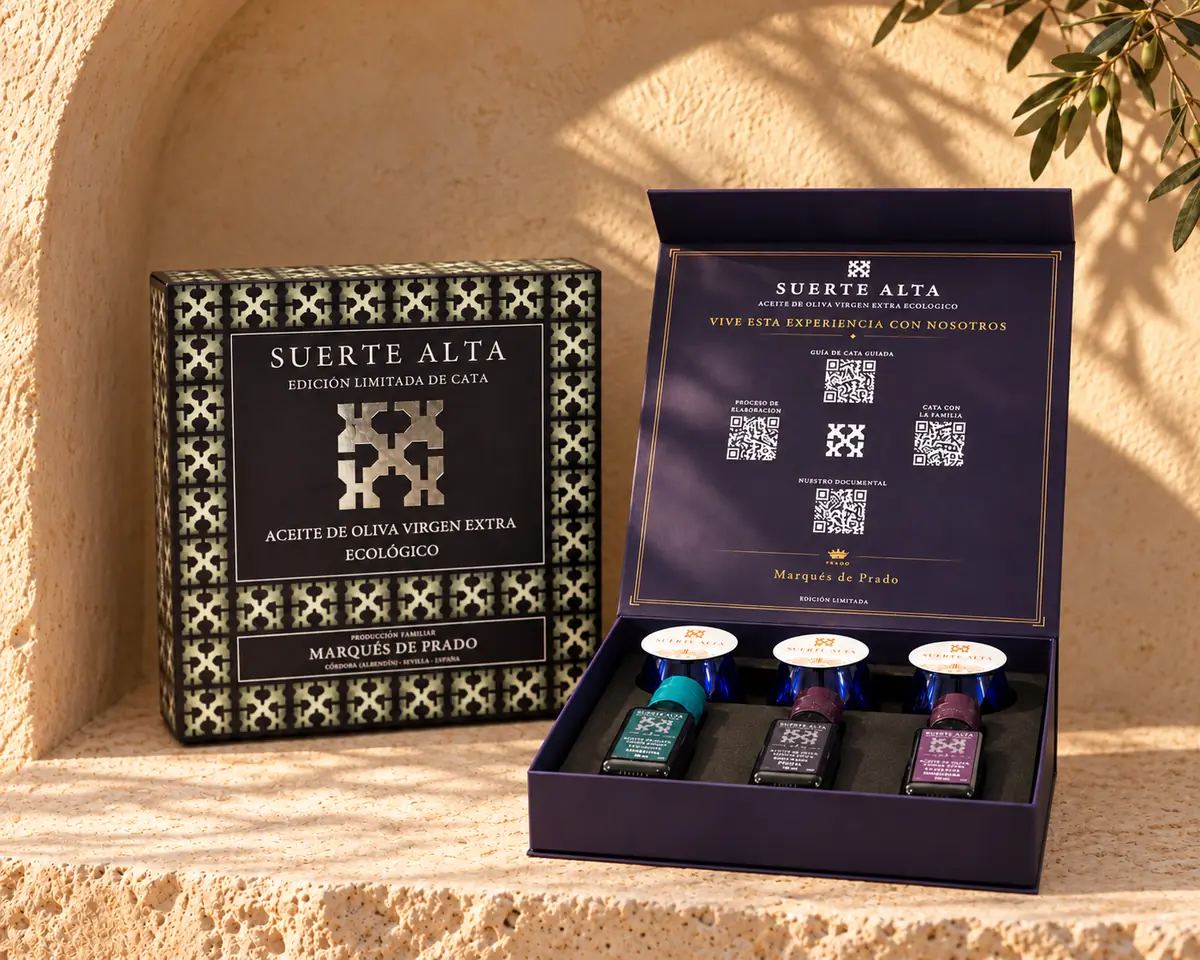
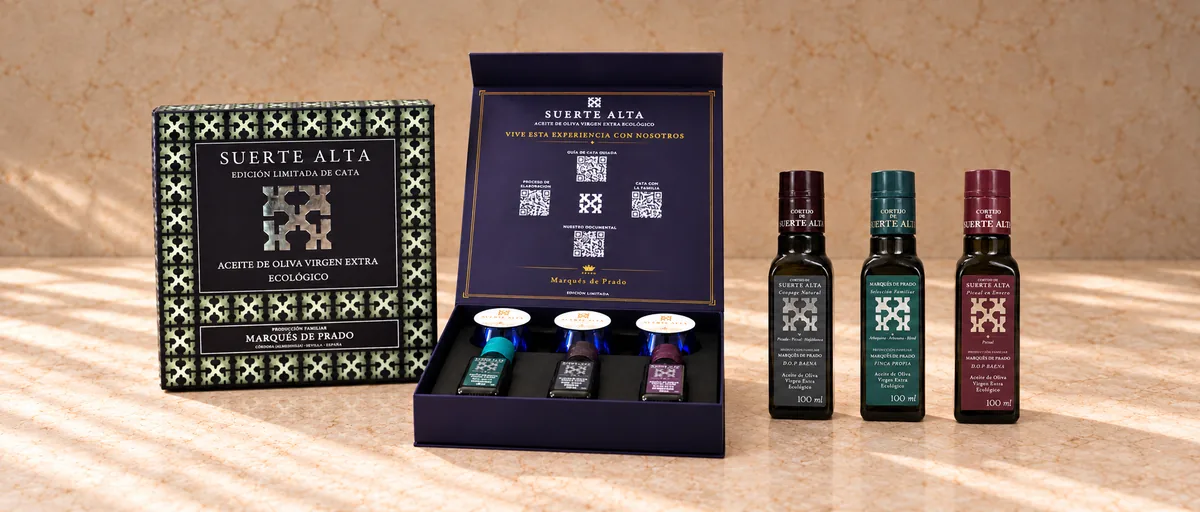
If you want the full experience without having to find glasses or choose oils, the Cortijo de Suerte Alta olive oil tasting kit has everything ready for you. It includes three organic PDO Baena oils in 100 ml bottles, three official tasting glasses in cobalt blue glass, a booklet for your notes and a QR code guide.
What I like most is that it’s a blind tasting. The bottles carry only a number, and you won’t know which oil was in each glass until the end. And the three oils couldn’t be more different.
Marqués de Prado is the mildest, with notes of green banana and apple; you can also find it in its 500 ml gift box. Coupage Natural is the most balanced, with freshly cut grass, almond and tomato leaf, and it’s also available in a 500 ml gift box. And Picual en Envero is the most intense of the three, with a bitterness and pungency that won’t go unnoticed; you’ll find it in a 500 ml bottle.
Will you be able to guess which is which? Here’s a clue: sweetness gives away the Marqués de Prado, and bitterness and pungency, the Picual en Envero.
Conclusions
Doing an olive oil tasting at home is much easier than it seems, and much more fun too. With a few glasses, two or three different oils and a little attention, you have the perfect plan for a long, relaxed meal with family or friends. And the best part comes afterwards: once you learn to tell one oil from another, you start choosing the one that best suits each dish.